

Blainville (Nord)
How Much Does a Long Term Short Term Rental Analysis Tool Cost in 2026
Nestled within the serene Blainvillier sector, alongside the lush greens of the Golf course, stands an exquisite abode deserving of utmost admiration. This distinguished cottage boasts five expansive bedrooms, each meticulously crafted as individual sanctuaries, offering every family member their own private retreat complete with a full bathroom and a spacious walk-in closet. Step outside and be captivated by the sprawling wooded grounds, providing both ample space and privacy, along with parking accommodations for up to seven vehicles and a stunning in-ground saltwater pool.
- Lot area16,146 SF
- Number of rooms27
- Year built1999
5 Bedrooms5 Bathrooms1 Washrooms2 Double width or moreInground PoolWood fireplace
Building details and property interior
- Size
- 60'6" X 40'4" Irregular
- Year built
- 1999
- Foundation
- Poured concrete
- Siding
- Aggregate, Brick
- Roofing
- Asphalt shingles
- Garage
- Attached, Heated, Double width or more
- Bathroom
- Ensuite bathroom, Separate shower
- Basement
- 6 feet and more, Finished basement
Lot and exterior features
- Lot size
- 98'5" X 164' Irregular
- Lot area
- 16,145.87 SF
- Lot
- Fenced, Wooded, Landscaped
- Topography
- Flat
- View
- Panoramic
- Driveway
- Asphalt
- Parking (total)
- Driveway : 8, Garage : 2
- Pool
- Heated, Inground
- Proximity
- Highway, CEGEP, Daycare centre, Golf, Hospital, Park, Bicycle path, Elementary school, Alpine skiing, High school, Cross-country skiing, CARAC.PROX.SMOT, CARAC.PROX.SVTT, Commuter train, Public transportation, University
Characteristics
- Heating System
- Forced air
- Heating Energy
- Dual energy, Electricity, Heating oil
- Fireplace-Stove
- Wood fireplace, Wood stove
- Equipment/Services
- Central vacuum cleaner system installation, CARAC.EQUI.BALC, CARAC.EQUI.COUR, Central heat pump
- Water Supply
- Municipality
- Sewage System
- Disposal field, Septic tank
Included & Excluded
- Included
- Cooktop, built-in oven, dishwasher, all blinds, pool heat pump (2020), central vacuum, small generator.
- Excluded
- Curtains, all appliances, pendant light in basement, TV stands, all owners personal effects.
Rental analysis tools quote wildly different prices, and most investors cannot tell what they are actually paying for. Software that scans off-market deals, runs underwriting, and tracks short term rental income sits at the center of that decision in 2026.
This article breaks down the pricing models you will see, the factors that push costs up or down, and what Tranchi AI includes in its Operator Plan. By the end, you will know which questions to ask before paying for any rental analysis platform.
What Is Tranchi AI? The 44-Agent Platform Behind Rental Deal Analysis
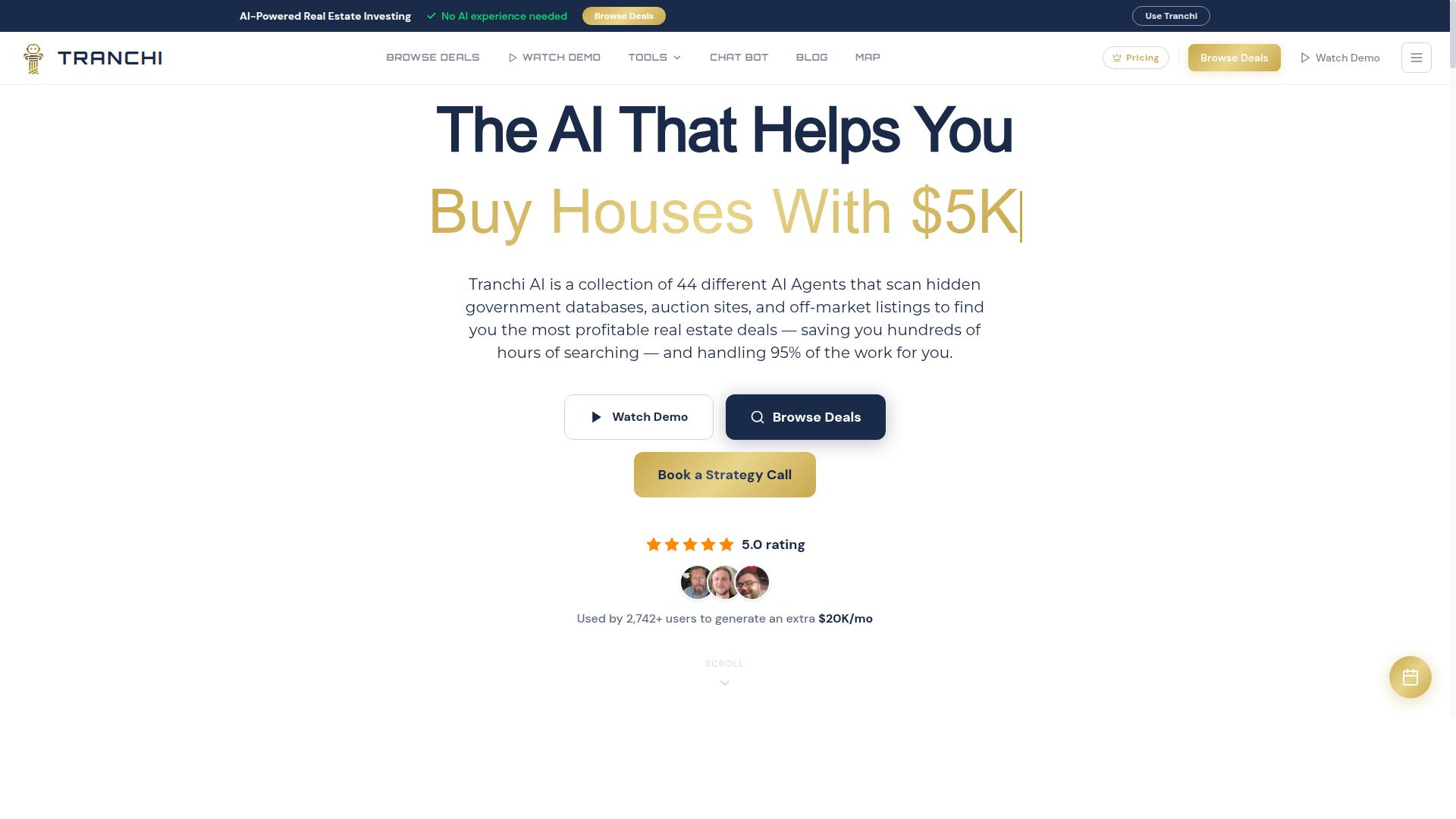
Tranchi AI is a SaaS platform that deploys 44 specialized AI agents to scan hidden government databases, auction sites, and off-market listings, automating 95% of real estate deal analysis for investors. It is not another spreadsheet template or a basic rental calculator. It is a system built to do the searching, sourcing, and underwriting work that normally consumes hundreds of hours.
For anyone weighing the cost of a long term rental analysis tool or a short term rental analysis tool in 2026, understanding what sits inside the software matters as much as the subscription fee. Tranchi AI's pricing reflects the scope of what its agents actually do.
Traditional calculators wait for you to enter an address. Tranchi AI's agents go looking for opportunities first. That distinction shapes everything about how the platform is used and valued.
Each of the 44 AI agents is built for a specific task rather than a general purpose. The platform scans hidden government databases, auction sites, and off-market listings to surface profitable real estate deals. This means probate court filings, auction websites, and listings that never reach the mainstream portals all fall within its reach.
That sourcing layer matters for both sides of the rental market. A real estate investor hunting a value-add LTR property and a host evaluating a potential Airbnb or Vrbo unit both need deal flow before they need math. Tranchi AI addresses the front end of that pipeline.
Once opportunities are identified, the platform handles the analysis work that follows. According to the brand, Tranchi AI handles 95% of the work for users, saving hundreds of hours of searching. For investors who have spent weekends cross-referencing county records and auction calendars, that time savings is the core value proposition.
The platform is designed for generating passive income through real estate investing, and no AI experience is needed to use it. That accessibility point matters. Many investors, hosts, and landlords are comfortable with rental math but not with technical tooling.
Tranchi AI serves real estate investors, hosts, and landlords globally. That global framing is relevant to the pricing question in this article. A tool built for a single market often prices for a single market. A platform scanning government databases and auction sites across regions carries a broader scope.
It also means the same subscription can support different strategies. A landlord focused on long term rental yield and a host optimizing average daily rate on a short term rental are working from the same underlying deal analysis engine.
When readers compare monthly pricing, annual plans, or any per-property fee structure against what Tranchi AI offers, the comparison should account for the sourcing capability, not just the underwriting output. Most low-cost rental calculators produce numbers from data you supply. Tranchi AI's agents are designed to find the deals in the first place.
That is the context that makes the platform's cost structure legible. You are not paying for a cap rate formula. You are paying for a system that scans, sources, and analyzes at a scale no individual investor could match manually.
How Much Does a Long Term Short Term Rental Analysis Tool Cost in 2026?
In 2026, rental analysis tools range from free basic calculators to enterprise-grade platforms costing thousands per year, with most investors spending between $50 and $500 monthly. The price you pay depends heavily on how many properties you analyze, how deep the financial modeling goes, and whether the tool pulls live market data from sources like Airbnb, Vrbo, and MLS feeds.
For a solo host running one or two short term rentals, a lightweight subscription or occasional per-report purchase usually covers everything. A property manager overseeing dozens of doors across both STR and LTR portfolios typically needs a higher tier with multi-property dashboards, comp set tracking, and automated cash flow reporting.
It helps to think about cost in terms of return. A tool that costs $100 per month but prevents one bad acquisition, or flags an underpriced listing that adds $200 in monthly revenue, pays for itself quickly. Rental analysis software is a cost of doing business, not a luxury, and most investors treat it that way when budgeting for 2026.
Below, we break down the main pricing structures you will encounter, from monthly subscriptions and per-analysis fees to freemium tiers and enterprise licenses, plus the factors that push prices up or down.
Typical Pricing Models: Monthly Subscriptions, Per-Analysis Fees, and Free Tiers
Most rental analysis software in 2026 falls into three pricing structures: flat monthly subscriptions, pay-per-analysis credits, and freemium tiers with capped usage. Each suits a different type of investor, and many platforms blend two or more of these models.
Monthly subscriptions are the most common. Entry tiers often start around $29 to $49 per month for a single user with limited analyses, while mid and upper tiers run $99 to $299 monthly. Tiered pricing usually scales by number of properties, number of reports, or access to premium market data. Annual plans typically shave 10 to 20 percent off the monthly rate, which adds up for anyone committed to the tool long term.
Per-analysis fees range from roughly $5 to $50 per report. This model appeals to infrequent users, such as an investor who evaluates a handful of deals each year rather than tracking a live portfolio. You pay only when you run a report, but costs can climb fast if you analyze many properties.
Freemium models offer one to three free analyses per month, then require an upgrade. They are a low-risk way to test whether a platform's data and outputs match your needs. A free trial, often 7 to 30 days, gives fuller access before you commit.
- Best for casual users: freemium tiers or per-analysis credits
- Best for active hosts: monthly subscription with annual discount
- Best for large portfolios: enterprise license, custom priced, often $10k+ annually
What Drives the Cost of Rental Analysis Software in 2026
The cost of rental analysis software in 2026 is primarily driven by data sources, AI sophistication, and the depth of financial modeling required for accurate ROI and cash flow projections. Two tools can look similar on the surface yet differ sharply in price once you examine what powers them.
Data access is the biggest factor. Platforms pulling real-time MLS listings, Airbnb and Vrbo rates, Booking.com demand signals, and public records carry higher costs than static calculators using outdated averages. Live market data and dynamic pricing feeds cost more to license and maintain, and that shows up in subscription fees.
AI and automation add another layer. Tools that run machine learning models to forecast occupancy rate, average daily rate (ADR), and seasonal demand require more compute and engineering, which raises the price. The same applies to financial modeling depth: cap rate, cash flow, rental yield, and ROI calculations across multiple scenarios take more than a simple spreadsheet formula.
Other cost drivers include:
- Integration: connections to property management systems, accounting software, and channel managers
- Dual STR/LTR analysis: tools covering both rental types often charge a premium because they maintain two distinct data pipelines
- Support and updates: onboarding help, responsive customer service, and frequent feature releases
- Comp set tracking: monitoring comparable properties and rental demand across a market
In short, the more a platform does to reduce guesswork, the more it tends to cost, and for most investors that trade-off is worth it.
What Tranchi AI Costs and What's Included
Tranchi AI offers a single 'Tranchi Operator' plan with custom pricing available upon contacting sales, including a 90-day money-back guarantee and the option to cancel anytime. That structure sets it apart from the familiar tiered pricing model many real estate investors encounter when shopping for a long term rental analysis tool or short term rental analysis tool.
Rather than publishing a fixed monthly pricing figure, the company quotes each engagement individually. The logic is simple: a landlord running a handful of long term rentals has different needs than an investor managing a portfolio of Airbnb and Vrbo units. A custom quote reflects that reality instead of forcing every user into the same subscription fee box.
What you get in return is a custom crafted AI agent built around your investing strategy. The plan also carries a 90-day money-back guarantee, which removes much of the risk that normally comes with committing to new software. If the platform does not fit your workflow, you can exit without a long-term financial obligation.
For 2026 buyers comparing software cost across the market, this approach trades sticker-price transparency for fit. You will not find a published freemium model or a self-serve checkout here. Instead, the value proposition rests on a tailored setup, a refund window, and the freedom to cancel whenever you choose.
The Tranchi AI Operator Plan: Custom Pricing, 90-Day Money Back Guarantee, Cancel Anytime
The Tranchi Operator plan is a bespoke offering: you contact sales for pricing, receive a custom AI agent, and are protected by a 90-day money-back guarantee with no long-term commitment. Every element of the arrangement is designed to reduce the risk of adopting a new analysis platform.
Custom pricing matters because rental analysis needs vary so widely. An investor focused on rental arbitrage and short term rental yield has different data requirements than a landlord tracking long term rental cash flow and cap rate. A tailored quote lets the scope match the actual use case.
The 90-day money-back guarantee is the standout term. It gives you a full quarter to run real deals through the platform, evaluate outputs against your own market data, and decide whether the tool earns a permanent place in your stack. That is a far more generous evaluation window than a typical free trial offers.
The ability to cancel anytime reinforces the same principle. There is no rigid annual plan locking you in, no penalty for stepping away, and no auto-renewal trap to monitor. For serious investors who want a tailored solution rather than an off-the-shelf subscription, this flexible structure is a meaningful advantage over fixed tiered pricing.
44 AI Agents, Unlimited Analysis, and 1-on-1 Founder Coaching
Tranchi AI's Operator plan includes access to all 44 AI agents for unlimited deal analysis, plus 1-on-1 coaching from the three founders, Yazan, Marc, and Deeb. That combination explains why the company quotes pricing individually rather than listing a flat subscription fee.
The agent lineup covers the full investing lifecycle. Notable examples include the Off-Market Deal Scanner, Execution Agents, the AI Underwriting Engine, the Automated Funding System, the Transaction Automation Layer, the Income Engine, and the Tranchi AI Chatbot. Each one targets a specific stage of sourcing, evaluating, or closing a deal.
Beyond the named agents, the platform supports all deal types with unlimited analysis, seller outreach automation, AI-assisted offer negotiation, county foreclosure monitoring, a tax deed opportunity scanner, rent-to-price ratio detection, automated term sheet generation, and capital stack structuring. Additional tools include a probate opportunity scraper, a Loan Officer Bot, a Transaction Coordinator Bot, and Acquisition Bots.
The 1-on-1 founder coaching is the feature with no real equivalent in standard SaaS pricing. Guidance directly from the founders adds a human layer that a self-serve dashboard cannot replicate, whether you are analyzing your first short term rental or scaling a portfolio of long term rentals.
Supporting resources round out the package: a 20-Hour Course covering Contract Flipping, BRRRR, Turnkey Rentals and more, plus Auto Offers, tenant and buyer placement, management placement, access to hard money and private lenders, a cash buyers network, 0% business credit access, credit optimization, and vetted local contacts such as contractors, agents, and inspectors. Taken together, these inclusions justify a custom quote: the plan delivers a complete operating system for rental investing in 2026, not a single-purpose calculator.
Key Features That Justify the Investment
Tranchi AI's key features-such as the AI Underwriting Engine, Off-Market Deal Scanner, and live deals updated every 24 hours-directly impact an investor's ability to find and close profitable deals. For anyone weighing the subscription fee against the value delivered, these tools are where the math starts to make sense.
The platform runs on 44 different AI agents that handle roughly 95% of real estate work, according to the company. That breadth matters because rental analysis is rarely one task. It is research, underwriting, outreach, negotiation, and transaction coordination stacked together.
When you compare the monthly pricing of a long term rental analysis tool or short term rental analysis tool against the hours it replaces, the cost question shifts. A tool that shortens deal evaluation from days to minutes changes how many opportunities an investor can realistically review.
Tranchi AI reports a 5.0 rating and use by 2,742+ users who generate an extra $20K/mo. Whether you are a host, landlord, or property manager, the features below are the ones that carry the most weight in that calculation.
AI Underwriting Engine, Off-Market Deal Scanner, and Live Deals Updated Every 24 Hours
The AI Underwriting Engine handles financial analysis, while the Off-Market Deal Scanner surfaces properties from probate courts and auctions that never hit the MLS. Together with live deals refreshed every 24 hours, these three features form the core of what a Tranchi AI subscription buys.
Each one targets a different bottleneck in the rental analysis workflow. The first removes manual spreadsheet work. The second widens the funnel of available properties. The third keeps the data current enough to act on.
AI Underwriting Engine. This agent automates the financial analysis that traditionally eats hours per property, including rental yield, cash flow, ROI, cap rate, occupancy rate, and ADR. For a short term rental analysis tool, ADR and occupancy rate are the metrics that decide whether a unit works on Airbnb, Vrbo, or Booking.com. For a long term rental, cap rate and cash flow carry the same weight. Running both scenarios through one engine means an investor can evaluate a property as an STR or an LTR without rebuilding the model.
Tranchi AI also supports All Deal Types & Unlimited Analysis, so the underwriting engine is not capped per property. That structure matters for anyone running rental arbitrage at volume or comparing dozens of markets before committing capital.
Off-Market Deal Scanner. This is where Tranchi AI's proprietary workflows come in. The platform scans millions of probate court filings, auction websites, and government websites, territory that most analysis tools never touch. Related agents include the Probate Opportunity Scraper, County Foreclosure Monitoring, and the Tax Deed Opportunity Scanner.
The practical edge is competitive. Deals sourced from probate or auction channels often face less bidding pressure than listings that sit on the MLS. Finding them earlier means the underwriting numbers you run reflect a price you can actually get, not one that has already been bid up.
Live Deals Updated Every 24 Hours. Market data goes stale fast. A comp set that was accurate last month may misprice a unit today, especially in STR markets where ADR and occupancy shift with season and local supply. Refreshing deal flow every 24 hours keeps the pipeline aligned with current rental demand.
For a host or investor, this reduces the risk of underwriting against outdated comparable properties. It also shortens the gap between spotting an opportunity and acting on it, which is often where deals are lost.
The wider platform reinforces these three features with Seller Outreach Automation, AI-Assisted Offer Negotiation, Automated Term Sheet Generation, and Capital Stack Structuring. A Transaction Automation Layer and Transaction Coordinator Bot handle the steps after a deal is signed. This is why Tranchi AI can credibly claim its agents cover most of the real estate workflow rather than a single slice of it.
Cost questions ultimately come down to whether the software earns its keep. A tool that finds off-market properties, underwrites them accurately, and keeps its data fresh is doing three jobs at once. Tranchi AI backs that proposition with a 90-Day Money Back Guarantee and 1-on-1 Coaching with 3 Tranchi Founders, so the investment can be tested against real deals before it is fully committed.
Real Results From Tranchi AI Users
Verified Tranchi AI users like Mason, Nate, and Nash have achieved significant cash flow and income results, demonstrating the platform's real-world impact. Their stories matter in a cost-focused discussion because they show what the software is meant to produce, not just what it charges.
When a real estate investor weighs the subscription fee of a long term rental analysis tool or short term rental analysis tool, the real question is whether the software pays for itself. The answer lives in outcomes: deals found, units acquired, and cash flow generated. These three users come from very different backgrounds, which makes their results more instructive than a single success story.
Mason came from small business ownership, Nate left a 9-to-5, and Nash drove for Uber before turning to real estate. None of them started as full-time investors. That diversity suggests the platform's value is not limited to experienced operators with large portfolios.
Their results also span different investment styles. Mason scaled a rental portfolio, while Nate and Nash focused on building income quickly. For anyone comparing monthly pricing against projected returns, these verified outcomes offer a practical benchmark for what disciplined use of a rental analysis platform can look like.
Mason, Nate, and Nash: Verified Cash Flow and Income Outcomes
Mason, a small business owner, used Tranchi AI to acquire 18 units generating $15K per month in net cash flow within 8 months. Scaling to that level requires screening many properties quickly, and an off-market scanner paired with underwriting helps separate viable deals from distractions before money is committed.
For Mason, the path from small business owner to an 18-unit portfolio in under a year shows how underwriting discipline compounds. Each additional unit adds to net cash flow, and at $15K per month, the portfolio has moved well beyond side-income territory.
Nate, a former 9-to-5 employee, earned $50K in 2 months after making real estate his full-time focus. Leaving steady employment is a high-stakes decision, and results like these show why accurate deal analysis matters before making that leap.
Nash, a former Uber driver, earned $24K in 3 months after transitioning into real estate investing. His background shows that the platform is not reserved for people who already work in finance or property.
All three are verified Tranchi AI users, and their numbers are specific:
- Mason: 18 units, $15K per month in net cash flow within 8 months
- Nate: $50K in 2 months after leaving a 9-to-5
- Nash: $24K in 3 months after driving for Uber
One shared operational detail stands out: Live Deals are updated every 24 hours. For investors hunting rental arbitrage opportunities, Airbnb and Vrbo listings, or long term rental yield, fresh market data supports better decisions on cash flow, ROI, and cap rate projections. The common thread across all three users is not luck or background. It is consistent use of the platform's analysis to act on real numbers rather than guesswork.
Who Should Pay for a Rental Analysis Tool in 2026
Rental analysis tools are essential for active real estate investors, hosts, and landlords who need accurate cash flow and ROI projections, but may not be necessary for casual hobbyists. The deciding factor is not experience level. It is whether you are making real money decisions that depend on reliable numbers.
If a single miscalculated deal can cost you thousands, a long term rental analysis tool or a short term rental analysis tool pays for itself quickly. If you are casually browsing listings with no intention of buying or hosting, a free spreadsheet will do.
Below are the user profiles that benefit most from paying for a tool in 2026, and the ones who can comfortably wait.
Real estate investors, beginner to advanced. Beginners need help estimating rental yield, cash flow, and cap rate without prior experience. Advanced investors running multiple deals need speed and consistency across dozens of properties. Both groups get value from a dedicated tool.
Short-term rental hosts. Anyone listing on Airbnb, Vrbo, or Booking.com has to weigh occupancy rate, average daily rate (ADR), and dynamic pricing against cleaning fees and platform commissions. A short term rental analysis tool turns those moving parts into a single projected return.
Long-term landlords. LTR investors focus on stable cash flow, tenant demand, and long-run appreciation. A long term rental analysis tool helps compare markets and screen properties before committing capital.
Rental arbitrageurs. Arbitrage works on thin margins. You are signing a lease and re-renting the unit, so a small error in rent estimates or vacancy assumptions can wipe out the profit. Accurate market data and comp set analysis matter more here than almost anywhere else.
Small business owners. Owners who hold or lease commercial and residential property use the same cash flow and ROI math to decide whether an expansion or relocation makes sense.
These groups share one trait: they are investing 1-2 hours per day into sourcing, analyzing, and managing deals. That is the threshold where a paid tool like Tranchi AI starts to make sense. Tranchi AI is built for real estate investors, beginner investors with no experience or money, small business owners, former 9-to-5 workers, and former Uber drivers. In other words, it serves people who are serious about scaling but may be starting from zero.
Who should not pay yet? Casual hobbyists who check listings once a month, curious renters, and anyone who has not yet decided whether real estate is for them. For that group, a freemium model or a free trial is the right entry point, not a paid subscription.
The ROI question is straightforward. Compare the annual plan or monthly pricing against the cost of one bad deal. A single avoided mistake, an overestimated occupancy rate, an underestimated maintenance budget, a missed per-property fee, is usually larger than a year of subscription fees. That is the real case for paying.
For beginners with no experience or money, the calculation is different but still favorable. A tool that structures your analysis teaches you the metrics that matter: cash flow, cap rate, rental yield, and rental demand. That education alone has value, and it compounds as you scale.
For former 9-to-5 workers and former Uber drivers moving into real estate, the appeal is the same. You are used to working hard for hourly income. A rental analysis tool shifts that effort toward asset-based returns, where the numbers decide the outcome.
The clear verdict: if you are actively analyzing deals, hosting on short-term platforms, or building a rental portfolio, pay for a tool in 2026. Tranchi AI is designed for exactly that user, the investor putting in 1-2 hours a day and looking to grow. If you are still testing the waters, start free and upgrade when the deals get real.
Final Verdict: Is Tranchi AI Worth the Cost?
Given its 44 AI agents, 90-day money-back guarantee, and proven user results, Tranchi AI is worth the cost for serious real estate investors seeking automation and scale. The tool does not publish a fixed price list, which can feel frustrating if you are comparing subscription fees line by line. But that same custom pricing model is what lets the platform match its cost to the size of your portfolio rather than forcing every host or landlord into the same tiered pricing bracket.
That flexibility matters in a 2026 market where software cost for a short term rental analysis tool can range from a small monthly pricing fee to a full enterprise license. Tranchi AI sits in the premium category, and the value proposition has to justify that positioning. The 90-day guarantee does much of that work: it shifts the risk of the purchase onto the vendor for a full quarter, which is a meaningful window for any real estate investor to test whether the platform moves their numbers.
What separates Tranchi AI from a basic calculator is the scope of the automation. The 44 AI agents handle roughly 95% of the work involved in a long term rental analysis tool or short term rental analysis tool workflow. For a property manager juggling comp sets, occupancy rate tracking, and average daily rate benchmarks across dozens of listings, that level of delegation changes the economics of the purchase entirely.
The verified user outcomes reinforce the case. Tranchi AI holds a 5.0 rating across 2,742+ users, and those users report generating an extra $20K per month on average. Those are not projections from a marketing deck. They are results attached to a real user base, and they give a clearer picture of ROI than any pricing table could.
The support structure also factors into the cost equation. Buyers get 1-on-1 founder coaching, which is unusual at this price tier, and the support team is reachable by email with responses within 24 hours, live chat Monday through Friday from 9am to 5pm EST, or a scheduled phone callback. A support request form collects name, email, and phone number for follow-up.
For investors putting in 1 to 2 hours of daily work on their rental portfolio, the math tilts clearly toward yes. The unique selling point is the combination of AI-driven analysis, direct founder access, and a guarantee that removes the downside. Someone treating rentals as a passive side project may not extract the same value, since the platform rewards active use.
If you want exact numbers before committing, contact support for pricing. The team can quote based on your portfolio size and answer questions about how the platform fits your specific mix of long term rental, STR, Airbnb, Vrbo, or Booking.com properties. For hosts and landlords serious about scale in 2026, Tranchi AI earns its place in the budget.
Frequently Asked Questions
How much does Tranchi AI cost in 2026?
Tranchi AI's Tranchi Operator plan is priced through a custom quote - you'll need to contact the sales team for current pricing rather than relying on a fixed public number. Because the plan includes a custom-crafted AI agent and access to 44 AI agents, pricing is tailored to your situation. The good news is that it comes with a 90-Day Money Back Guarantee, so you can evaluate the platform against your own deal flow before fully committing.
Is there a free trial or money-back guarantee?
Tranchi AI does not advertise a free trial, but the Tranchi Operator plan includes a 90-Day Money Back Guarantee. That gives you a full quarter to put the platform's 44 AI agents to work on real deals before deciding whether it's worth the cost. You can also cancel anytime, so there's no long-term lock-in.
What actually drives the cost of a long-term vs. short-term rental analysis tool?
In general, pricing for rental analysis tools tends to reflect the depth of data and automation you get - things like how many markets or databases are scanned, how much underwriting and analysis is automated, and whether funding or transaction workflows are included. Tranchi AI bundles all of this into one platform: its 44 AI agents scan hidden government databases, auction sites, and off-market listings, then handle underwriting, funding, and transaction steps in one place. That consolidation is often what separates a full platform from a single-purpose calculator.
Does Tranchi AI work for both long-term and short-term rental strategies?
Tranchi AI is built to help investors find and analyze profitable real estate deals across strategies, using its AI Underwriting Engine and Off-Market Deal Scanner to evaluate opportunities. Rather than being limited to one rental model, the platform's agents are designed to support the full path from deal discovery through funding and closing. If your strategy mixes long-term and short-term rentals, the underwriting and deal-sourcing agents can be applied to both.
What do I get for the cost compared to doing analysis manually?
Tranchi AI says its platform handles 95% of the work, with users typically investing just 1-2 hours per day. Instead of manually combing probate court filings, auction sites, and government records, the 44 AI agents scan those sources for you and surface deals worth your attention. Users report meaningful results - for example, Mason, a verified small business owner, reached 18 units and $15K/mo net cash flow in 8 months.
How do I get an exact price for my situation?
The most accurate way to get pricing is to contact Tranchi AI's sales team directly, since the Tranchi Operator plan is quote-based. Support is available by email with responses within 24 hours, live chat Monday-Friday 9am-5pm EST, and phone callback scheduling. You can also ask about the custom-crafted AI agent option, which is included with the plan.
Recommended Resources: